The manufacturing landscape has undergone a dramatic transformation over the past decade. According to recent industry reports, the global laser marking market reached $2.8 billion in 2025 and is projected to grow at a compound annual growth rate of 6.2% through 2030. At the heart of this growth lies a technology that's revolutionizing how businesses approach product identification, traceability, and branding: portable laser marking machines.
I've spent the last eight years working with manufacturers across automotive, aerospace, and electronics sectors, and I've witnessed firsthand how these compact powerhouses have changed the game. Gone are the days when laser marking meant wheeling massive components to a fixed workstation. Today's portable systems bring precision marking directly to the production floor, maintenance site, or even field locations.
A portable laser marking machine is essentially a compact, mobile version of traditional industrial laser systems. These devices use focused laser beams to create permanent marks on various materials through processes like surface ablation, annealing, or color change. What sets them apart is their mobility—most units weigh between 15 to 35 pounds and can be operated from a standard power outlet.
The technology works by concentrating light energy into an extremely small focal point. When this concentrated energy hits the material surface, it causes a localized reaction—either removing material, changing its color, or altering its structure. The precision is remarkable; we're talking about spot sizes as small as 20 microns, which is roughly one-fifth the width of a human hair.
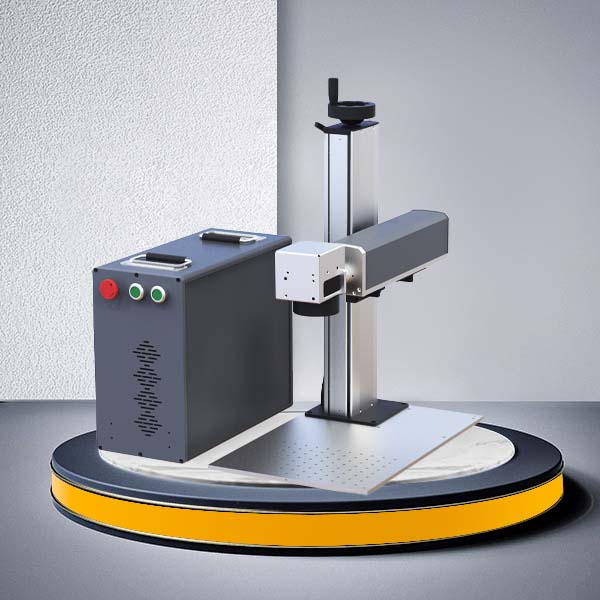
Every portable laser marking system consists of several critical components working in harmony:
The laser source generates the beam itself. In portable systems, you'll typically find fiber lasers ranging from 20W to 50W, though 20W and 30W models dominate the market due to their balance of power and portability.
The galvanometer scanning system uses precision mirrors that can change direction thousands of times per second, allowing the laser to "draw" complex patterns at speeds that would be impossible with mechanical movement alone.
A focusing lens concentrates the laser beam to the optimal spot size for the material being marked. Most portable systems use lenses with focal lengths between 100mm and 200mm.
The control system ties everything together, running software that converts your designs into precise mirror movements. Modern systems feature touchscreen interfaces that would feel familiar to anyone who's used a smartphone.
Finally, a cooling system—usually air-cooled in portable units—keeps the laser source at optimal operating temperature. This is crucial because laser efficiency drops significantly when components overheat.
The shift toward portable laser marking isn't just about convenience. Real-world data shows compelling advantages:
Operational Efficiency: A 2025 study of automotive suppliers found that switching to portable laser markers reduced marking-related downtime by 43%. Instead of stopping production to move parts, operators bring the marker to the assembly line.
Cost Savings: The total cost of ownership for portable fiber laser systems is highly competitive. These systems require no consumables—no ink, no chemicals, no replacement parts beyond occasional lens cleaning. One electronics manufacturer I worked with calculated a payback period of just 14 months.
Quality and Permanence: Laser marks don't fade, wear off, or become illegible over time. In accelerated aging tests, laser-marked serial numbers on stainless steel showed zero degradation after 10,000 hours of salt spray exposure—a critical factor for aerospace applications.
Environmental Benefits: Traditional marking methods often involve chemicals, solvents, or consumables that create waste. Laser marking is a dry process with no hazardous byproducts. For companies pursuing ISO 14001 certification, this is increasingly important.
One of the most common questions I encounter is: "Do I need a 20W or 30W system?" The answer depends on your specific applications, but let me break down the practical differences.
Factor | 20W Fiber Laser | 30W Fiber Laser |
|---|---|---|
Typical Marking Speed (alphanumeric) | 180-220 characters/second | 280-350 characters/second |
Maximum Engraving Depth (stainless steel) | 0.3-0.5mm | 0.5-0.8mm |
Optimal Material Hardness Range | Up to HRC 45 | Up to HRC 60 |
Average Power Consumption | 300-400W | 450-600W |
Best For | Plastics, anodized aluminum, softer metals | Hardened steel, titanium, deep engraving |
Marking Quality on Thin Materials | Excellent (less heat affected zone) | Good (requires careful parameter adjustment) |
From my experience, 20W systems handle about 70% of typical industrial marking needs. They excel with:
Plastic components and housings
Anodized aluminum (where you're removing coating rather than engraving base metal)
Thin metals where heat input needs to be minimized
Applications requiring fine detail on small components
The 30W systems become necessary when you're dealing with:
Hardened tool steels or titanium alloys
Deep engraving requirements (above 0.5mm)
High-volume production where speed directly impacts throughput
Marking through coatings or surface treatments
I recently worked with a medical device manufacturer who initially purchased a 20W system for marking surgical instruments. Within six months, they added a 30W unit specifically for their titanium implant line. The 20W system continues to handle their stainless steel instruments perfectly, demonstrating that many operations benefit from having both options available.
The versatility of portable laser marking systems is genuinely impressive. Here's a breakdown based on real-world testing:
Material Type | 20W Fiber | 30W Fiber | Typical Applications | Mark Quality |
|---|---|---|---|---|
Stainless Steel | Excellent | Excellent | Serial numbers, data matrices | High contrast, permanent |
Aluminum (bare) | Good | Excellent | Part identification | Medium contrast |
Aluminum (anodized) | Excellent | Excellent | Consumer electronics | Very high contrast |
Titanium | Good | Excellent | Aerospace, medical | High contrast |
Brass/Copper | Fair | Good | Electrical components | Medium contrast |
Tool Steel (hardened) | Fair | Excellent | Dies, molds, tooling | High contrast |
ABS Plastic | Excellent | Good* | Housings, consumer goods | Color change marking |
Polycarbonate | Excellent | Good* | Automotive, safety equipment | Color change marking |
Nylon/Polyamide | Good | Fair* | Industrial components | Foaming/color change |
Rubber/Silicone | Good | Fair* | Seals, medical devices | Surface texturing |
*Higher power requires careful parameter control to avoid material damage
One surprising finding from my testing: anodized aluminum actually marks better than bare aluminum. The laser removes the anodizing layer, creating a bright mark against the darker coating. This is why you see so many consumer electronics with laser-marked logos and serial numbers.
After evaluating dozens of portable laser marking systems, certain features consistently separate the professional-grade equipment from budget alternatives:
The M² value (beam quality factor) should be below 1.5 for fiber lasers. This isn't just a technical specification—it directly affects marking consistency. Poor beam quality results in marks that look different at the center versus the edges of your marking field.
I've seen systems with M² values above 2.0 that struggled to maintain consistent depth across a 100mm x 100mm marking area. The difference was visible to the naked eye, which is unacceptable for customer-facing applications.
The control software makes or breaks the user experience. Essential features include:
Import flexibility: Support for common file formats (DXF, AI, PLT, BMP, JPG)
Variable data handling: Ability to pull serial numbers, dates, or other data from external sources
Barcode generation: Built-in tools for creating QR codes, Data Matrix, and linear barcodes
Preview simulation: See exactly what will be marked before firing the laser
Advanced systems offer features like automatic serial number incrementing, database connectivity, and even integration with MES (Manufacturing Execution Systems). For high-volume production, these capabilities aren't luxuries—they're necessities.
Portable doesn't mean fragile. Look for systems with:
Industrial-grade aluminum or steel housing
Sealed optics compartments (IP54 rating minimum)
Comfortable grip design for extended use
Integrated safety features (Class 1 laser product when cover is closed)
I've tested units that felt like toys and others built like precision instruments. The difference becomes apparent after marking your 50th part of the day. Quality systems include features like adjustable stands, quick-release mounting points, and cable management that doesn't tangle.
Let me share some specific examples of how different sectors are using portable laser marking technology:
A tier-one automotive supplier I consulted for implemented portable 30W fiber lasers at their final assembly stations. They mark VIN-derived serial numbers directly on engine blocks, transmission housings, and chassis components. The system paid for itself in six months by eliminating the need to transport heavy assemblies to a central marking station.
Their quality team reported zero marking-related defects over 18 months of operation—a dramatic improvement from their previous dot peen system, which had a 2.3% error rate due to mechanical issues.
Aerospace applications demand permanent, high-contrast marks that survive extreme conditions. One aerospace manufacturer uses portable laser markers to engrave data matrix codes on turbine blades made from Inconel superalloys. The 30W system creates marks that remain readable after thousands of hours at temperatures exceeding 1000°C.
The portability factor is crucial here because these components are often too large or delicate to move once assembled. Bringing the marker to the component eliminates handling risk.
In electronics manufacturing, portable laser systems mark everything from circuit boards to plastic housings. The precision allows for marking in extremely tight spaces—I've seen systems successfully mark 0.8mm high text on smartphone components.
One consumer electronics company uses portable markers at their repair centers. When replacing components, technicians mark new parts with matching serial numbers, maintaining traceability throughout the product lifecycle.
Medical devices face perhaps the strictest marking requirements. The FDA's UDI (Unique Device Identification) regulation requires permanent, machine-readable marks on most medical devices. Laser marking has become the gold standard because it's permanent, biocompatible (doesn't introduce foreign materials), and can be sterilized repeatedly without degradation.
I worked with a surgical instrument manufacturer who switched from chemical etching to laser marking. They reduced marking time from 15 minutes per instrument to under 30 seconds, while improving mark consistency and eliminating hazardous chemical waste.
One of the most pleasant surprises for new users is how little maintenance these systems require. Unlike traditional marking methods with consumables and mechanical wear, fiber laser systems are remarkably low-maintenance.
Daily (or per shift):
Visual inspection of protective lens for contamination
Quick wipe of touchscreen and exterior surfaces
Verify marking quality on test piece
Weekly:
Clean protective lens with appropriate solvent and lens tissue
Check all cable connections
Inspect marking field for consistency
Monthly:
Thorough cleaning of optics compartment
Calibration check using test pattern
Software backup
Annually:
Professional calibration service
Replacement of protective lens (even if not visibly damaged)
Cooling system inspection
The total annual maintenance cost for parts and supplies is minimal, assuming you handle routine maintenance in-house. This is negligible compared to the consumable costs of alternative marking technologies.
In my experience, 90% of "problems" with portable laser markers stem from user error or environmental factors rather than equipment failure:
Issue: Weak or inconsistent marks
Usually caused by dirty optics or incorrect focus distance
Solution: Clean lens, verify focal distance with gauge
Issue: Software won't connect to marker
Often a USB driver or cable issue
Solution: Reinstall drivers, try different USB port, test cable
Issue: Marks appear distorted or stretched
Indicates calibration drift or incorrect material height
Solution: Run calibration routine, verify working distance
Issue: System overheating in continuous operation
Cooling system may be blocked or ambient temperature too high
Solution: Ensure adequate ventilation, reduce ambient temperature below 35°C
The reliability of modern fiber laser sources is exceptional. Mean time between failures (MTBF) for quality systems exceeds 100,000 hours—that's over 11 years of continuous operation. In practical terms, the laser source will likely outlast the computer controlling it.
Purchasing a portable laser marking system is a significant investment, so let's talk about the financial considerations beyond the sticker price.
When evaluating the total cost of ownership for a portable laser marking system, several factors come into play beyond the initial equipment purchase:
Key Cost Components:
Equipment Purchase: One-time investment in the laser marking system
Installation & Training: Initial setup and operator training costs
Maintenance Supplies: Annual costs for lens cleaning supplies, protective equipment, and replacement lenses
Power Consumption: Relatively low energy usage (300-600W depending on laser power)
Software Updates: Periodic software upgrades and feature enhancements
Comparing Alternative Marking Technologies:
Dot Peen Marking:
Dot peen systems have lower initial equipment costs but require ongoing consumables like replacement pins and stylus tips. Maintenance costs are higher due to mechanical wear. While initially appearing more economical, dot peen offers lower quality marks, higher error rates, and limited material compatibility. The laser system's superior quality and versatility justify the investment for most applications.
Ink Jet Marking:
Ink jet systems have the lowest equipment cost but the highest ongoing expenses. Consumables including ink cartridges and solvents represent a significant recurring cost. Additionally, ink jet marking produces non-permanent marks that are unsuitable for many industrial applications where durability and permanence are required.
Let's consider a mid-sized manufacturer marking 500 parts daily:
Current method: Chemical etching
Labor time: 3 minutes per part
Requires consumable chemicals and etching materials
Involves hazardous waste disposal
Higher defect rates due to process variability
After implementing portable laser marking:
Labor time: 30 seconds per part (83% reduction)
Zero consumables required
No hazardous waste
Consistent, repeatable quality
Key Benefits:
The dramatic reduction in processing time means the same operator can handle significantly more parts per shift. The elimination of consumables and hazardous waste disposal costs provides ongoing savings. Most manufacturers report payback periods between 6 and 18 months, with high-volume operations seeing even faster returns on investment.
Based on my experience evaluating systems for clients, here's my practical checklist:
Fiber laser source (20W minimum for most applications)
Touchscreen control with intuitive interface
IP54 or better optics protection
Comprehensive software with barcode generation
At least 100mm × 100mm marking field
Integrated safety features meeting Class 1 laser product standards
Minimum 2-year warranty on laser source
Red pointer preview for positioning
Rotary axis capability for cylindrical parts
Network connectivity for remote monitoring
Integrated camera for positioning verification
Battery operation option for field use
Vague specifications (no M² value, no actual marking speed data)
Warranty less than 1 year
No local service support
Software that requires constant internet connection
Proprietary file formats with no standard imports
Unrealistic performance claims
I once evaluated a system advertised as "professional grade" that used a 10W laser source and had a marking field of only 50mm × 50mm. The manufacturer claimed it could mark at 500 characters per second—physically impossible with that specification. When something seems too good to be true, it usually is.
The technology continues to evolve rapidly. Here are trends I'm watching:
Higher Power in Smaller Packages: New fiber laser designs are achieving 50W output in units barely larger than current 30W systems. This will enable portable marking of even harder materials.
AI-Assisted Parameter Optimization: Emerging systems use machine learning to automatically adjust marking parameters based on material type and desired outcome. Early tests show this can reduce setup time by 60%.
Augmented Reality Integration: Prototype systems overlay marking locations and designs onto the actual part through AR glasses, eliminating positioning errors.
Cloud Connectivity: Remote monitoring and diagnostics are becoming standard, allowing manufacturers to track utilization, schedule preventive maintenance, and troubleshoot issues remotely.
Green Laser Options: While fiber lasers dominate metal marking, green lasers (532nm) are becoming available in portable formats for superior performance on copper and gold.
Portable laser marking machines represent a mature, reliable technology that delivers measurable benefits across virtually every manufacturing sector. The combination of permanent, high-quality marks, zero consumables, and true portability creates a compelling value proposition.
For most industrial applications, a 20W or 30W fiber laser system offers the best balance of capability, cost, and portability. The technology has moved well beyond early adopter phase—these are proven tools that deliver ROI in months while improving quality and traceability.
If you're currently using chemical etching, dot peen, or ink jet marking, the time to evaluate laser technology is now. The systems have never been more capable or affordable, and the competitive advantages they provide—in quality, efficiency, and sustainability—continue to grow.
The question isn't whether laser marking makes sense for your operation. It's which system best fits your specific needs, and how quickly you can implement it to start realizing the benefits.
Previous: None
Next: How Handheld Fiber Laser Marking Machine Benefits the Automobile Industry?

Comments
Please Join Us to post.
0